
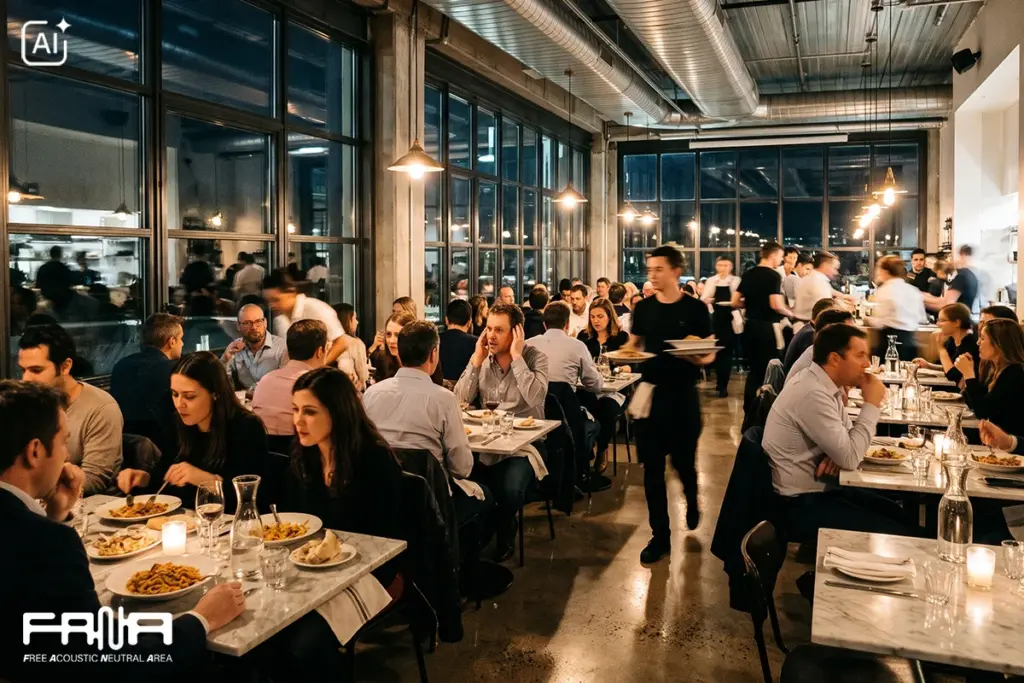
Noise inside a venue is not a matter of atmosphere. It is a measurable physical phenomenon, and research over the past decade shows tangible effects on three fronts: how long guests stay at the table, how they perceive the taste of what they eat and drink, and how well front-of-house and kitchen staff can do their jobs.
It gets little attention because it is a discomfort that rarely goes on record. Guests do not fill in a complaint form about noise: they simply do not come back, or they mention it in an online review alongside vaguer grievances (“didn’t feel comfortable”, “too chaotic”). Industry surveys, however, have been saying something different for years: noise is among the leading causes of dissatisfaction reported by venue customers, second only to the quality of service.
What the data on venue noise really say
Zagat surveys carried out in the United States in recent years have repeatedly ranked noise as the first or second most common complaint among restaurant-goers, ahead of prices and crowding. Field measurements by researchers and food critics regularly record sound levels of around 80 dB(A) in restaurants at peak times, with peaks above 90 dB(A) in the busiest venues — compared with roughly 60 dB(A) for normal conversation, according to the National Institute on Deafness and Other Communication Disorders (NIDCD, a US federal agency).
It is not just a question of volume. Above all, it is a question of how sound behaves inside the room.
Reverberation: why a full venue turns into a chaotic one
The technical parameter describing how much a space “holds on to” and reflects sound is reverberation time (RT60), defined by the ISO 3382 series of international standards: the time it takes for the sound level to decay by 60 dB after the source has stopped. The harder and more reflective the surfaces — glass, concrete, metal — the longer the RT60.
For spaces where people need to understand each other in conversation — restaurants, bars, meeting rooms, schools — acoustic engineers recommend a target RT60 below 1 second. Beyond that threshold, words overlap, guests instinctively raise their voices to be heard, and that collective rise in volume pushes the background noise up in turn: it is a self-reinforcing loop, and the reason a full venue “explodes” acoustically even though nobody, individually, is shouting.
Noise changes taste too
Here the research is less intuitive but solid. Charles Spence, an experimental psychologist at Oxford, published a review in Flavour in 2014 summarising decades of laboratory studies on the subject: loud background noise selectively impairs our ability to perceive certain tastes, notably sweet and sour, while other components of flavour remain relatively less affected. The mechanism is not yet fully understood at a neuroscientific level, but the effect has been replicated in several independent studies.
The practical consequence for anyone running a venue: a technically well-executed dish can come across as bland or unbalanced to the guest, simply because they tasted it in an environment that was too noisy.
It is not only a problem for guests: staff work in the same noise
Noise exposure at work is a regulated matter, not an opinion. NIOSH (the US National Institute for Occupational Safety and Health) recommends that average exposure should not exceed 85 dB(A) over 8 hours to protect workers’ hearing: above that threshold, every 3 dB increase halves the exposure time considered safe. In Italy the reference is Legislative Decree 81/2008, which sets action values at 80 and 85 dB(A) and a daily exposure limit value of 87 dB(A). During a busy service or in a noisy kitchen, catching an order on the fly, communicating with a colleague two metres away or staying focused for an entire shift becomes objectively harder in an acoustically poor environment — however skilled the staff may be.
The World Health Organization, in its 2018 Environmental Noise Guidelines, also places chronic noise exposure among the factors affecting cognitive fatigue, stress and quality of life, not just hearing in the strict sense.
How a venue’s acoustics are measured
A noisy venue is not an unchangeable fact: it is a problem that can be measured with objective instruments and corrected with targeted interventions. The reference technical parameters, defined by the ISO 3382 and IEC 60268-16 standards, are:
- RT60 — reverberation time: how long sound “bounces” around the room.
- SPL (Sound Pressure Level) — the equivalent sound level perceived when the venue is in operation.
- STI (Speech Transmission Index) — an index from 0 to 1 measuring how intelligible speech is; above 0.60 is considered good, above 0.75 excellent.
- C50 / C80 — the clarity of speech and music, i.e. the ratio between the sound energy arriving “directly” in the first milliseconds and the energy arriving later as reflections.
An on-site technical measurement, carried out while the venue is closed using certified instruments, shows precisely how tiring the venue is for conversation, how much real noise it generates when full and which interventions — sound-absorbing panels, adjustments to the table layout, management of the audio system — are genuinely needed, avoiding spending on generic or oversized solutions.
What changes for venues that certify their acoustics
Measuring indoor acoustics and intervening where needed is not (only) a technical adjustment: it is a way of making verifiable something that has so far remained a subjective impression — “this place is chaotic”, “you can breathe here”. FANA (Free Acoustic Neutral Area) was created precisely for this: to certify the acoustic comfort of venues technically, through qualified engineers, and to issue a certificate that owners can show their guests as an objective guarantee, not a slogan.
Frequently asked questions
What is a reasonable sound level for a venue at peak times?
Field measurements show that many restaurants already reach 80 dB(A) at their busiest. A space designed for conversation should stay well below that threshold, with an RT60 below 1 second.
How are a venue’s indoor acoustics measured?
With certified sound level meters and protocols compliant with the ISO 3382 standard, recording RT60, SPL, STI and C50/C80 while the venue is closed.
Is structural work needed to improve acoustics?
In most cases, no: targeted sound-absorbing panels, reverberation control at critical points and a more considered table layout can significantly reduce the problem without building work.
Does noise really affect the taste of food?
Yes. Spence’s scientific review (2014) documents a reduced perception of sweet and sour tastes in the presence of loud background noise, based on several independent laboratory studies.
Is an acoustic certification a subjective assessment?
No. It is a technical measurement based on objective parameters (RT60, SPL, STI, C50/C80), carried out by qualified engineers and fully documented.
How long does an acoustic measurement in a venue take?
Typically around 60–90 minutes, with the venue closed and under controlled conditions.
Want to know how much “invisible” noise there is in your venue? A FANA technical measurement reveals, with objective data, what your guests don’t say but feel every time they walk in.
👉 Request your FANA acoustic certification
Sources: C. Spence, “Noise and its impact on the perception of food and drink”, Flavour, 2014 (BioMed Central, open access) — NIDCD/NIH, “Noise-Induced Hearing Loss” — NIOSH, “Criteria for a Recommended Standard: Occupational Noise Exposure”, 1998 — Italian Legislative Decree 81/2008, Title VIII, Chapter II — WHO/Europe, “Environmental Noise Guidelines for the European Region”, 2018 — ISO 3382-2, reference standard for measuring reverberation time in ordinary rooms.