
Anyone who works in hospitality knows that noise is a problem. But for years it has been treated as a matter of style — of interior design choices, of aesthetic sensibility — rather than as a public health issue or something deserving institutional attention. That is beginning to change.
In December 2025, at Italy’s Chamber of Deputies, a new cross-party parliamentary group called Benessere Acustico (Acoustic Wellbeing) was formally launched. It was set up on the initiative of MP Luciano Ciocchetti, deputy chair of the Social Affairs Committee, with the backing of Udito Italia, an organisation long active in hearing health prevention. It is the first time that acoustic comfort in public venues has appeared, explicitly, on an Italian parliamentary agenda.
It is worth understanding clearly what this is — and what it is not — to avoid either inflated expectations or the opposite mistake of dismissing a signal that the sector should not ignore.
What the group is actually about
The group was established primarily as a public health initiative, not as a policy response to the restaurant industry. Its driving concern is hearing loss prevention and the impact of noise pollution on human health. Its work is organised around three strands:
- Hearing health — preventing noise-induced hearing damage and promoting listening awareness, in collaboration with the scientific and medical community.
- Sound quality — engagement with industries designing and producing sound technologies.
- Acoustic quality of everyday environments — this is the strand that is directly relevant to bars and restaurants.
Within this third strand, the group references WHO standards for concert halls, restaurants, nightclubs and public spaces. This is not a regulation. It is not a requirement. It is a policy orientation — a signal that institutional attention is turning towards a subject that has, until now, sat largely outside public debate in Italy.
That said, the fact that restaurants appear — for the first time — on a parliamentary agenda alongside concert halls and nightclubs is not trivial. It indicates a direction. And in policy terms, directions tend to precede rules.
The scientific context: what the WHO actually says
The most robust reference point on this subject is the Environmental Noise Guidelines for the European Region (WHO, 2018): a systematic review of several hundred studies, which identifies noise as one of the leading environmental threats to physical and mental health in Europe. Documented effects include sleep disturbance, chronic stress, hypertension and increased cardiovascular risk.
It is worth clarifying a figure that circulates widely, even in authoritative sources: the claim that noise is ‘the second-largest environmental health risk in Europe’. Depending on the source, it is attributed either to the WHO or to the European Environment Agency. The two bodies make the same point — after air pollution, noise is the environmental factor with the greatest impact on health in Europe — but these are estimates based on the available scientific literature, not a fixed official ranking. They should be cited as estimates, with the source named each time.
For venues, the implications are direct: people who frequent bars and restaurants are regularly exposed to noise levels that, in many settings, exceed the thresholds associated with negative health effects in the research literature. This is not a future problem: it is already present, already measured, already documented.
Restaurant noise: the numbers that matter
A Doxa survey commissioned by Groupon, carried out in 2018 and still the most widely cited Italian study on the subject, found that 58% of Italians said they felt irritated by noise in venues — the single biggest source of dissatisfaction when eating out, ahead of slow service and high prices.
The figure dates from 2018 and should be read as such. The direction it points to — noise as the leading source of dissatisfaction in venues — is, however, confirmed by more recent research carried out in other European countries.
There is also a second, less obvious dimension. Studies reported by Linkiesta in October 2025 document an effect that is arguably more commercially significant: excessive background noise reduces the ability to perceive flavour and aroma. A dish served in a noisy environment is not just less comfortable to eat — it is, in measurable terms, perceived as less good. Acoustics are not merely aesthetic. They are part of the gastronomic experience itself.
What this means for venue owners today
On a regulatory level, nothing changes for now. There are no new obligations, no parameters or noise limits imposed on public venues. The parliamentary group is a policy body, not a piece of legislation.
What is shifting is the broader context. Acoustic comfort is becoming a matter of public interest — following the same trajectory as other areas of hospitality, such as indoor air quality, accessibility and sustainability, where cultural pressure came first, institutional attention followed, and regulation arrived eventually. That sequence is not inevitable for acoustics, and its timeline is uncertain. But the first institutional signal has arrived.
For venue owners, the practical consequence is this: addressing acoustics now means doing so ahead of a growing trend, not catching up with one already consolidated. It also means being able to document it — not simply telling guests that a space is quiet, but being able to demonstrate it with objective technical data.
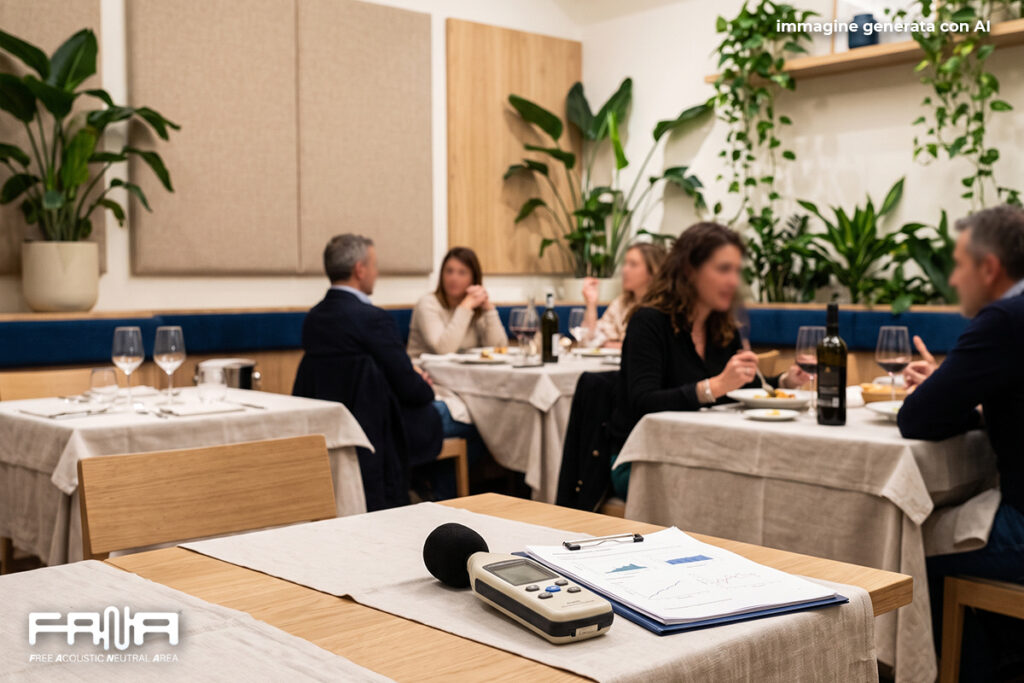
This is the principle behind FANA certification: not a self-declaration or a subjective judgement, but a technical measurement carried out to ISO 3382, the international standard for acoustic comfort assessment in enclosed spaces. The key parameters include reverberation time (RT60) — how long sound persists in a space after the source stops — and equivalent sound pressure level (SPL). These are reproducible, comparable, certifiable figures. They are the difference between believing a venue is acoustically comfortable and knowing it is.
Frequently asked questions
Has the Acoustic Wellbeing group introduced new rules for bars and restaurants?
No. There is currently no regulatory requirement for venues. The group is a cross-party parliamentary body for discussion and policy direction, not a law or regulation. Its significance is cultural and programmatic rather than immediately legislative.
Who established the group and with what aims?
It was set up on the initiative of MP Luciano Ciocchetti, deputy chair of the Chamber of Deputies’ Social Affairs Committee, with the support of Udito Italia. Its primary purpose is hearing loss prevention and the promotion of acoustic wellbeing as a public health concern.
What is the connection to restaurants specifically?
One of the group’s three work strands covers the acoustic quality of everyday environments, with an explicit reference to WHO standards that includes restaurants and public spaces, alongside concert halls and nightclubs. This is a policy orientation, not a binding standard or defined legislative timetable.
Is the ‘second environmental health risk’ figure from the WHO or the European Environment Agency?
It is attributed inconsistently in Italian press coverage — some sources cite the European Environment Agency, others the WHO. The two bodies agree: after air pollution, noise is the environmental factor with the greatest impact on health in Europe. These are scientific estimates, however, not a fixed official ranking, and the two sources should be cited separately.
Does noise genuinely affect how food tastes?
Yes. Several psychoacoustic studies document that excessive background noise reduces the ability to perceive flavours and aromas. The effect is not marginal: it influences the overall guest experience and, consequently, how quality is perceived.
What can a venue owner do now to address acoustics?
The first step is an objective technical measurement of the space to the ISO 3382 standard (RT60 and SPL), which establishes the actual acoustic baseline before any decisions are made about intervention. FANA certification includes this measurement and provides verifiable documentation of a venue’s acoustic comfort.